Integrate SonarQube in your TFS or VSTS Build

Since the last update to TFS we also have the build steps available to easily integrate SonarQube in your Visual Studio CI process. If you don’t have a SonarQube instance running you can set up one in Azure in nearly no time. Set up service endpoint for SonarQube First you have to set up a service endpoint for your SonarQube instance in TFS or VSTS. Go to the settings of your project (“manage project”), go to services and click “New Service Endpoint”. Select “Generic” and enter the URL to your SonarQube instance and the credentials to connect with. Add and … Continue reading Integrate SonarQube in your TFS or VSTS Build

Setup SonarQube in Azure VM

If you have installed and integrated SonarQube once in TFS 2012 you know it was really painful. But a lot of things have changed and now it’s really easy to setup a new SonarQube instance in Azure and integrate it into you build process and in Visual Studio. I did it this week and it was really fast and straight forward. Setup a machine in Azure I wanted to have a machine for trainings and demos. That’s why I decided to use SQL Server 2014 on Windows 2012 R2. Like this I can turn the machine on and of easily. … Continue reading Setup SonarQube in Azure VM

ALM Days 2016 in Köln

In einem Monat ist es soweit: die ALM Days finden dieses Jahr in Köln am 13. und 14. April statt. Wie jedes  Jahr geht es hier rund um die Themen Application Lifecycle Management, agile Entwicklung und natürlich DevOps. Als Speaker sind wieder viele Experten von Microsoft aus Deutschland und den USA und viele meiner MVP Kollegen. Die Anmeldung ist noch offen. Wer sich also bisher noch nicht angemeldet hat, kann das jetzt noch tun. Jetzt anmelden Die ALM Days sind für mich eine der besten Veranstaltungen im Jahr. Man kann sehr gut kontakte Pflegen und bekommt wirklich immer das aktuellste … Continue reading ALM Days 2016 in Köln

How to move build definitions in TFS to other projects using the REST API

The new build system in TFS or VSTS supports saving build definitions as templates. The problem is, that this only works inside a single TFS project. If you want to share your definition with other projects you have to use the REST API. First you have to extract your current build definition. Get a list of all build definitions and check the ids. Then use this ID to get the full definition. Now save the json to a file and remove all the clutter like _links, revision etc. I’ve marked all the sections that you can remove in the following … Continue reading How to move build definitions in TFS to other projects using the REST API

Missing files in MSDeploy package

Problem If you create an MSDeploy package for a SharePoint or O365 AddIn (a.k.a App) in a team build the package does not include all files (like i.e. language resources). Reason This seems to be a bug in MSDeploy. If you build the app only with /p:Ispackaging=True everything works fine. You get a web package inside the app.publish folder that contains all files. If you work with multiple Publishing Profiles and specify an explicit profile strange things happen. /p:DeployOnBuild=true /p:PublishProfile=NameOfPackageProfile You still get the package but if you look inside the package the folders are missing. Solution If you can … Continue reading Missing files in MSDeploy package

Release management trial license has expired

The license of the Release Management Server at one of my client expired multiple times. This time I was really sure that I had installed the correct version from MSDN. When I looked around I found the answer on msdn. As it turned out the problem is not, that the license had expired. The user under which the application pool is running has to load a user profile to read the license. This can be configured in iis. Continue reading Release management trial license has expired

Bugs not on the backlog after Update

If you Update yout TFS on premise from 2013 to 2015 or from 2015 to 2015 Update 1 you might experience that your bugs are no longer displayed in your backlog. This is can now be configured for individual teams. Open the settings for your project. Click on the team that you want to configure. Got to settings and configure how the bugs are handled in the backlog of the team. The bugs then appear again on your backlog. What you shouldn’t do is modify the workitem categories like some posts suggest. If you do this you will lose the capability … Continue reading Bugs not on the backlog after Update

Set assembly and app version to a matching build name in TFS 2015 or VSO Build.VNext

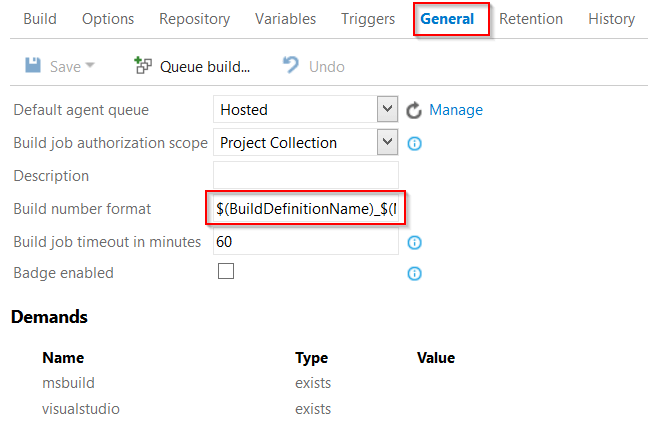
One of the most common customizations in TFS XAML build templates was to automatically update the assembly version number. This can also be done in build vNext using a small power shell script. I also added the option to apply … Continue reading Set assembly and app version to a matching build name in TFS 2015 or VSO Build.VNext

Trigger a vNext Release from build in TFS 2013/2015 on premise

I always had a lot of problems triggering a release from a build (Vnext or Xaml) on premise if I work with agentless deployments. In the cloud this works like a charm – but on premise it never worked for me. I tried it with the blog post on msdn – but no success. Today I started to use Fiddler to monitor the api calls that the Release Management Client makes. (BTW: I know now, why the app is so slow if you have limited network bandwidth. The client is really chatty!). With Fiddler and the Invoke-RestMethod commandlet its quite … Continue reading Trigger a vNext Release from build in TFS 2013/2015 on premise